
Key Takeaways
- Embedded World 2026 attracted a record 1,262 exhibitors in Nuremberg, March 10–12, 2026.
- The EU Cyber Resilience Act’s vulnerability reporting requirements are expected to begin applying around September 2026, with full compliance phases extending into 2027–2028. The whole industry is already preparing.
- Arduino is being taken seriously as a production platform, especially following the Qualcomm partnership.
- Edge AI is no longer an emerging trend. NPUs are becoming standard silicon at every power level.
- Zephyr RTOS is gaining serious momentum, and Rust is increasingly seen as a credible language for embedded development.
- Spotflow exhibited with its own booth, demoing firmware observability for connected device fleets.
- Our CEO Jan Kucera pitched Spotflow at EW: Spotflow cuts firmware troubleshooting time from 2 days to 12 minutes by giving embedded teams observability into their field-deployed devices.
Spotflow at Embedded World 2026
Spotflow set up in Startup City, Hall 2, Booth 2-412C at Embedded World 2026, the dedicated innovation hub of Embedded World, where over 100 startups, investors, and industry leaders gather across more than 1,000 m².
Walking into the hall on the morning of March 10th, the energy was immediately clear. More exhibitors, more products, and everywhere you looked more intelligence built into hardware that used to be completely dumb. We were excited and ready for the conversations ahead. Our roll-up banner was up, the Spotflow stickers were on the table, and the demo was ready to go.
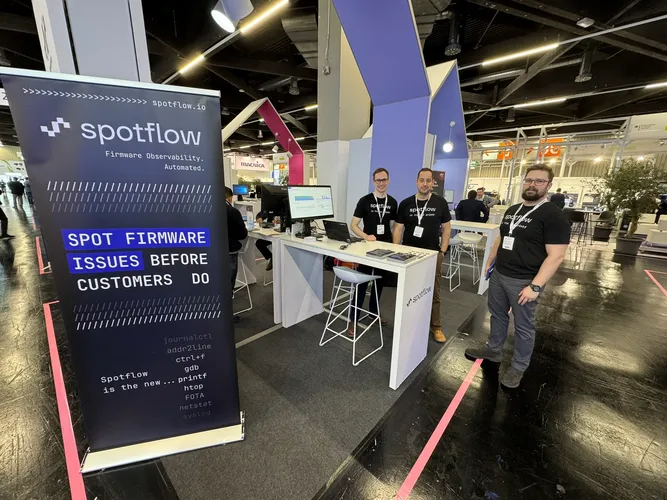 Spotflow's booth at Embedded World 2026.
At the Booth: What We Showed and Heard
We demoed Spotflow’s core capabilities: fleet health monitoring, remote log and metric drilldowns, firmware regression detection, and automated crash dump analysis.
Most visitors had no runtime observability in place. The most common setup we encountered was a single MQTT client shipping business data and logs together to a custom backend. That approach breaks down as fleets grow and teams need to query, correlate, or triage across devices.
Several visitors assumed “monitoring” meant compile-time static analysis. Clarifying “runtime monitoring” resolved the confusion immediately.
Device constraints and connectivity came up often: questions about LoRa, Bluetooth, and Zigbee, and concerns about RAM, CPU, and battery budgets.
Data residency was a hard requirement for medical and defence visitors. Data security and compliance were top of mind for everyone, especially with the EU Cyber Resilience Act (CRA) on the horizon.
Zephyr appeared frequently on roadmaps but was not yet in production for most teams. The majority were still on bare metal or FreeRTOS, with Zephyr adoption blocked by time or management priority.
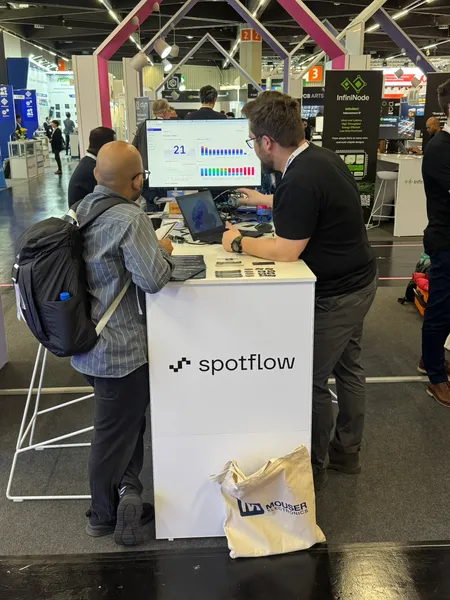 Visitors at the Spotflow booth at Embedded World 2026.
Embedded World 2026 Trends We Observed
After the morning rush at the booth, we took turns touring the halls and absorbing what the rest of the industry was showing. Here are the trends that stood out most, drawing on what we saw firsthand and backed up by analyst coverage from Forbes / Moor Insights and New Electronics.
1. CRA & Security: Regulation Is No Longer a Future Problem
The EU Cyber Resilience Act is already reshaping how embedded products are designed. Vulnerability reporting requirements, including a mandatory early warning for actively exploited vulnerabilities within 24 hours (followed by a full notification within 72 hours), are expected to begin applying around September 2026, with full compliance phases extending into 2027–2028. For hardware teams, even that longer horizon feels tight: silicon design cycles are measured in years, and CRA requirements reach into product architecture, not just documentation.
Major vendors across the show floor are shipping or racing to align with CRA requirements: hardware roots of trust, secure boot, lifecycle key management, and software bills of materials (SBOMs). ONEKEY demonstrated tooling for ongoing CRA compliance monitoring. Lattice announced an FPGA family with post-quantum cryptography support. SCI Semiconductor showed an MCU with hardware-enforced memory safety at the silicon level. These are early products: signals of where the industry is heading, not a solved problem across the board.
The open-source angle adds its own layer of pressure: most embedded products depend on open-source components, and CRA’s SBOM requirements mean every dependency must be tracked and vulnerability-managed. Teams treating open-source as an informal supply chain are already accumulating regulatory risk, and the tooling to manage it is still catching up.
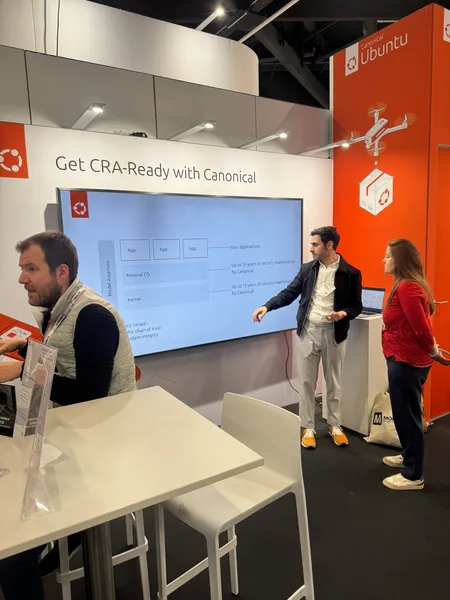 CRA compliance was a major theme at Embedded World 2026.
2. Arduino as a Serious Development Platform
Arduino is no longer just a hobbyist ecosystem. Now part of the Qualcomm family, Arduino announced the Arduino Ventuno Q: a robotics-focused computer built around a dual-brain architecture pairing the Qualcomm Dragonwing IQ8 (up to 40 dense TOPS NPU) with an STM32H5 microcontroller for hard real-time control. This combination solves a core limitation of single-processor boards like Raspberry Pi: running AI inference and issuing precise, low-latency commands at the same time, on separate silicon.
A key design principle is fully offline operation. The board runs models from Qualcomm AI Hub, Edge Impulse, or custom engines entirely on-device, including local LLMs like Qwen. Built-in capabilities cover speech recognition, text-to-speech, gesture detection, pose estimation, and YOLO-X object tracking, all without an internet connection.
3. AI Everywhere: From Your Coding Tool to the Device Itself
Edge AI had broad representation across the show floor. On the hardware side, NPUs (neural processing units) are being integrated into microcontrollers, SoCs, and even wireless chips. Vendors including Ambiq, STMicroelectronics, NXP, MediaTek, and Synaptics demonstrated AI-capable silicon across a range of power levels, from always-on inference in energy-harvested MCUs to 50+ TOPS application processors targeting robotics and industrial automation.
On the software and tooling side, AI is appearing in parts of the development workflow as well: AI-assisted code generation, AI-powered test automation, and agentic pipelines aimed at shortening the loop from specification to working firmware.
The practical options for embedding AI capabilities (both in devices and in tooling) have expanded noticeably. Whether any of these are worth adopting depends on the product and context.
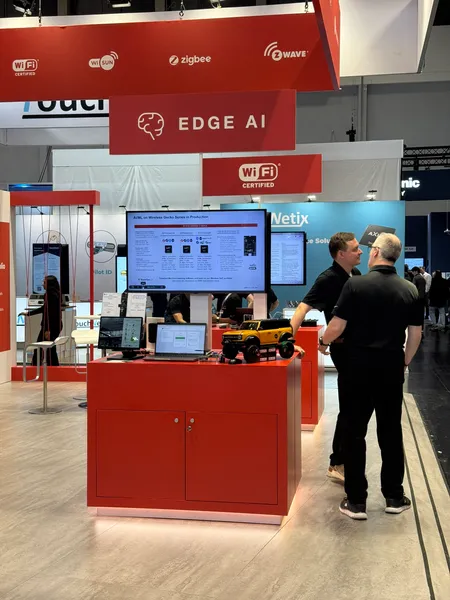 AI was everywhere at Embedded World 2026, from silicon to software.
4. Industrial IoT: Managing Complexity in Distributed Device Networks
Mesh networking and Industrial IoT came up frequently in our conversations at the booth, even though it did not make the headline trend lists in most analyst write-ups. Teams building distributed sensor networks, factory automation systems, and field-deployed edge devices are dealing with real, hard problems: device discovery, reliable connectivity in RF-noisy environments, and managing software across heterogeneous hardware.
This is not a new problem, but the scale is increasing. As devices get smarter and more connected, the operational burden of keeping a fleet running and knowing when something goes wrong grows with it.
5. Zephyr & Rust: The Open-Source Stack Gains Serious Ground
The Zephyr RTOS ecosystem is expanding quickly and picking up real momentum. Across the hall we saw Zephyr-based SDKs, developer tools, and production platforms from a growing number of vendors. Canonical’s acquisition of Golioth, an IoT device fleet management platform with first-class Zephyr RTOS support announced just before EW26, is a strong signal that the ecosystem is maturing into enterprise-grade territory.
Rust is increasingly being talked about as a viable language for embedded development. Not yet mainstream, but the sentiment has clearly shifted from skepticism to serious evaluation. Engineers who dismissed Rust for embedded two years ago are now prototyping with it.
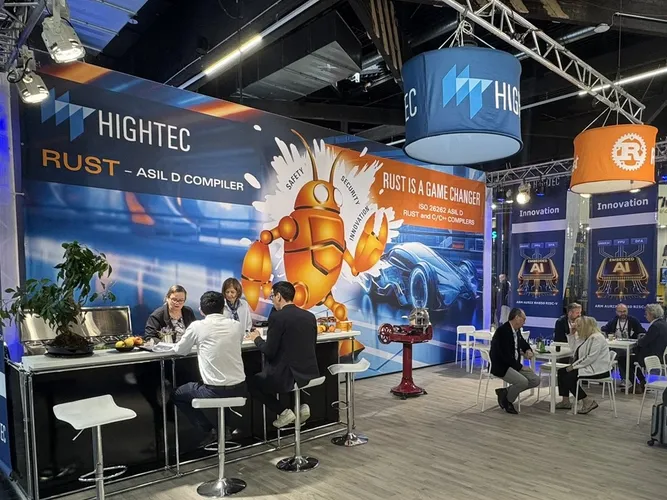 Zephyr RTOS and Rust are gaining momentum in embedded development.
CEO Pitch: Jan Kucera on Stage at Startup City
Jan opened with a customer quote: “Our firmware engineer spent two days troubleshooting the firmware issue.”
After firmware ships, most teams have limited visibility into what devices are doing in the field. Typical troubleshooting involves manually decoding error codes, SSH sessions, Ctrl+F through log files, correlating telemetry across disconnected tools, and losing data already overwritten in ring buffers. As fleets grow and update cadences increase, this approach does not scale. CRA adds further pressure around firmware lifecycle tracking and vulnerability management.
Spotflow collects logs, metrics, and crash dumps via a device SDK, surfaces them through dashboards and automated analysis, and provides root cause analysis with fix suggestions. In practice, this cut troubleshooting time from 2 days to 12 minutes, a 70% reduction.
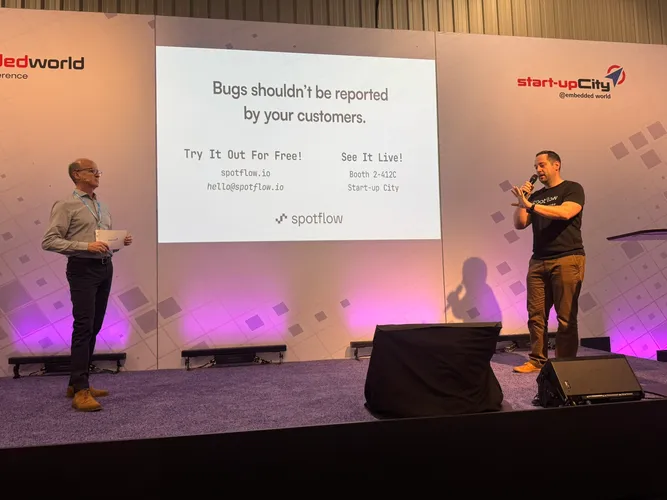 Spotflow CEO Jan Kucera pitching on stage at Embedded World 2026.
Wrapping Up: See You at EW27
On behalf of the entire Spotflow team: EW26 was a great experience. The conversations at our booth were exactly the kind we hoped for, engineers dealing with real problems, talking openly about what is hard about running connected firmware at scale.
We came away with a clearer picture of the problems that Spotflow solves, and with a lot of energy to keep building. The trends from EW26, smarter devices, stricter security requirements, more complex fleets, are exactly the forces that make firmware observability more important, not less.
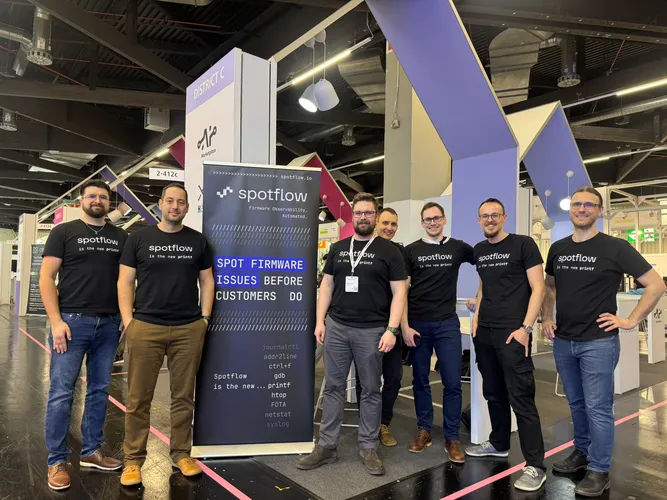 The Spotflow team at Embedded World 2026.
We look forward to seeing you at Embedded World 2027.
Want to see how it works? Explore the Spotflow documentation to learn how to integrate firmware observability into your connected device fleet. Ready to get started? Sign up for Spotflow, no credit card required. Questions or feedback? Reach out on Discord or email hello@spotflow.io.